How Fin actually works
Your mental model for how Fin responds to customers and generates answers.
When you switch on an AI agent, you’re not enabling a single feature, you’re configuring a system. Fin is made up of multiple features that interact to determine how conversations are answered, routed, and experienced. This lesson gives you a mental model you can anchor to so you understand how the pieces connect, why they matter, and how to use them intentionally
This lesson is part of the Launch Fin course.
Video transcript
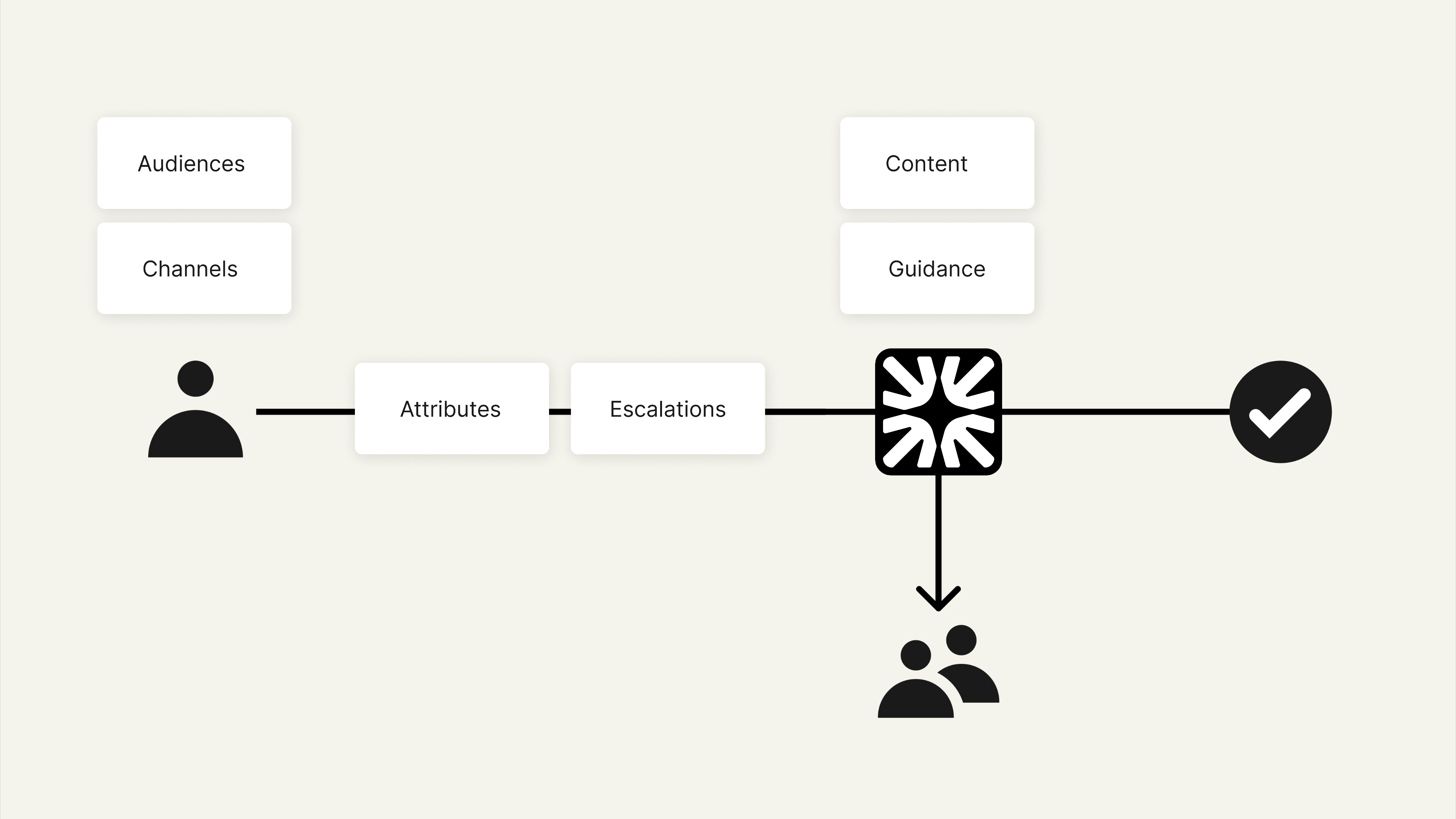
For a lot of teams, an AI agent kind of feels like a black box. You switch it on, it starts answering questions, but you're not quite sure what's happening inside. We don't want you to feel that way about Fin. At its core, Fin is built from a few simple pieces. You've got content and guidance, attributes, escalations, and channels and audiences. Let me show you how these things work together to enable Fin to handle your customer experience. So at the most basic level, when a customer asks a question, Fin is going to attempt to answer it using your content and your guidance. Now content gives Fin knowledge. And what I mean here is it gives it the actual information that it needs to answer the question. And guidance shapes how it behaves, how it should speak, respond, and interact with your customers. If the answer works, great. The conversation gets resolved. If not, Fin automatically passes it to your team. Simple. But what if something more complicated comes in or if we always want Finn to escalate certain things to our team instead of it trying to answer? Well, one of the best things about Fin is that before it tries to answer, the first thing it does is just read the conversation. Okay. What's this actually about? Well, seems to be like a billing issue and the customer seems a bit frustrated. So that's that's going to be negative sentiment and seems pretty urgent. So, yeah, let's mark it as urgent. So Fin actually classifies the conversation for you. And these attributes are just examples. You can create as many as you want about what ever you want. This means that Fin evaluates every conversation within the framework of your business. Okay. So attributes are what Fin uses to read and analyze each conversation. And once Fin knows what the conversation is about, it can decide what to do with it. Now, this is where the concept of escalations comes into play. You can tell Fin to escalate certain conversations straight to your team. So escalations can be really specific. Like we could say, if this conversation is about pricing, send that to the billing team. Or they can be more general. Like if a customer mentions our competitor by name, just escalate that to the team. Meaning, we can create escalation rules for pretty much any situation. Okay. So content and guidance help Financer. Attributes help it understand what each conversation is about. And escalations are like a filter, enabling us to remove certain topics, customers and conversations from Fin and send them straight to our team. So right now, any customer who writes in will get this experience. But we also have full control over who even sees Fin in the first place. You can choose the channels Fin appears on and pick exactly which audiences see it. Maybe you only want your logged in users to see Fin or maybe just everyone on web chat, or maybe it's everyone everywhere. The point is it's really easy to control exactly who gets the Fin experience. So when you zoom out, Fin isn't a mystery. It's just all these pieces interacting. And once you see how they connect, everything else starts to make sense.
Fin’s core components
These are the foundational pieces behind every rollout. Everything you configure in this course connects back to this structure.
.fin-quality-table th, .fin-quality-table td { text-align: left; vertical-align: top; padding: 18px 16px; } .fin-quality-table th { font-weight: 700; background: transparent; } .fin-quality-table tbody tr:nth-child(odd) td { background-color: #e9e6e3; } .fin-quality-table tbody tr:nth-child(even) td { background-color: transparent; }
| Component | What it does |
|---|---|
| Channels | Where conversations enter your system. |
| Audiences | Who is eligible to interact with Fin. |
| Attributes | How conversations are interpreted and classified. |
| Escalation Rules | The boundaries that define when a human must step in. |
| Content | The information Fin draws from to generate answers. |
| Guidance | The behavioral standards that shape how Fin responds. |
| Workflows | The orchestration layer that connects these pieces into a cohesive customer experience. |